Category: Uncategorized

  • EDiHTA to be presented at the European Patients’ Forum Congress 2025

    EDiHTA to be presented at the European Patients’ Forum Congress 2025

    EDiHTA joins the first EPF Members’ Circle

    The EDiHTA project will be featured at the European Patients’ Forum (EPF) Congress 2025, taking place on 26–27 November 2025 in Brussels. The EPF Congress is one of Europe’s key events for advancing patient leadership, bringing together patient organisations, policymakers, healthcare professionals, researchers and industry representatives to strengthen the role of patients in shaping the future of healthcare.

    On 26 November, Alexis Strader, Director of Policy and Research at the European Health Management Association (EHMA), will present a poster showcasing EDiHTA’s work on developing a European framework for the ethical and inclusive assessment of digital health technologies.

    The EDiHTA framework aims to improve how digital health tools, such as AI, telemedicine and medical devices, are evaluated and adopted across Europe, ensuring that innovation remains fair, transparent and centred on real healthcare needs.

    A core part of this effort is the EDiHTA Patient Advisory Group, which includes representatives from nine European countries and diverse disease areas. The group plays a crucial role in ensuring that patient experiences and expectations directly inform how digital technologies are assessed and implemented.

    By combining collaboration, ethics and patient engagement, EDiHTA contributes to building a more inclusive, trustworthy and patient-centred digital health ecosystem in Europe.

    Learn more about EDiHTA’s patient involvement and visit the EPF Congress website for programme details and registration information.


    The European Patients’ Forum is a key partner in the EDiHTA project, contributing its expertise in patient engagement and advocacy to ensure that patient voices are central to the development of the European framework for digital health technology assessment.

  • EDiHTA joins the first EPF Members’ Circle

    EDiHTA joins the first EPF Members’ Circle

    EDiHTA joins the first EPF Members’ Circle

    We were delighted to participate in the first session of the European Patients’ Forum (EPF) Members’ Circle, a dedicated platform for open dialogue and knowledge exchange within the EPF community.

    The session brought together over 20 patients and patient representatives from across Europe to explore EDiHTA’s mission and progress, presented by our Project Manager, Emmanouil Tsiasiotis and our partners from the Norwegian Centre for E-health Research. Together, we discussed key policy insights from EDiHTA on data protection, cybersecurity and the European Health Data Space (EHDS), focusing on how these developments affect patients’ rights and the assessment of digital health technologies.

    The conversation highlighted the growing role of patients in shaping digital health policy and evaluation frameworks, emphasising collaboration and transparency as essential elements in advancing trustworthy digital health innovation. This first session marks the beginning of a three-part Members’ Circle series with the two additional sessions to follow in 2026, continuing the exchange between patient organisations, researchers and policymakers.


    We extend our gratitude to the European Patients’ Forum for hosting this insightful session and to all participants for their valuable contributions and engagement. Stay tuned for updates on the next sessions of the Members’ Circle and follow EPF’s updates.

  • European Projects Insight Report: Showcasing the power of EU-Funded digital health collaboration

    European Projects Insight Report: Showcasing the power of EU-Funded digital health collaboration

    EDiHTA consortium charts the path forward at its 4th General Assembly in Barcelona

    We are delighted to share that the European Projects Insight Report has been officially published on the HIMSS website. Developed as part of the HIMSS European Projects Initiative 2025, the report captures the strategic direction, systemic challenges and transformative potential of 12 EU-funded digital health initiatives, including EDiHTA.

    The report was created by a cross-sectoral Advisory Board comprising experts from HIMSS, the European Commission, national health ministries, patient organisations, academia, health tech and international organisations such as the OECD. Through a multi-phase collaborative process, the Advisory Board reviewed project materials and presentations, contributing more than 160 recommendations, including 82 project-specific insights tailored to each participating initiative.

    The 12 projects featured, CYLCOMED, EDiHTA, ENTRUST, FLUTE, Gravitate-Health, IDERHA, MedSecurance, NEMECYS, ONCOVALUE, SHAIPED, TRUMPET and XiA, represent the diversity and innovation driving Europe’s digital health transformation. The report highlights key lessons and practical recommendations to enhance policy alignment, stakeholder engagement, data governance, interoperability, and sustainability across EU-funded initiatives.

    As a member of this collaborative effort, EDiHTA is proud to contribute to advancing digital health solutions that improve patient outcomes, foster innovation, and support the digital transformation of healthcare systems across Europe.

  • EDiHTA consortium charts the path forward at its 4th General Assembly in Barcelona

    EDiHTA consortium charts the path forward at its 4th General Assembly in Barcelona

    EDiHTA consortium charts the path forward at its 4th General Assembly in Barcelona

    The EDiHTA consortium gathered last week in the heart of Catalonia for its 4th General Assembly, hosted by our partners from Agency for Health Quality and Assessment of Catalonia (AQuAS). Over two days, partners met to discuss progress, share insights and shape the next steps in developing Europe’s first flexible framework for digital health technology assessment.


    From design to implementation

    Set in the modernist surroundings of AQuAS headquarters, the meeting opened with a warm welcome from the host team and remarks from the coordination partners at Università Cattolica del Sacro Cuore (UCSC). The first sessions dived into the evolving structure of the EDiHTA framework — with presentations from AQuAS, Hospital Clínic de Barcelona (HCB/FCRB), and DNV outlining advances in evidence requirements, platform architecture and digitalisation.

    Day one also featured updates on the first pilot phase from UCSC and a deep-dive into Task 4.3 on methodology validation and stakeholder mapping led by Odense University Hospital (OUH). As the day came to a close, discussions continued over dinner, where participants reflected on how EDiHTA is transitioning from design to real-world testing.


    Strategic alignment and stakeholder inclusion

    The second day focused on preparing for the project’s next milestones. UCSC and EITH shared plans for the second pilot phase, while AGENAS guided a lively discussion on exploitation strategy and sustainability. The session by EHMA explored synergies with related European projects, and EPF led an engaging conversation on patient involvement — a crucial element in ensuring that EDiHTA remains patient-centred and inclusive.

    The assembly concluded with a forward-looking planning session for 2026, setting the stage for upcoming pilot activities and the long-term vision for framework uptake and policy integration.


    A collective effort towards impact

    The Barcelona General Assembly meeting captured the collaborative spirit of EDiHTA: 17 partners from across Europe working together to advance the assessment of digital health technologies. The two days were marked by open discussion, strategic alignment and shared commitment to the project’s mission, supporting Europe’s transition towards evidence-based, harmonised digital health evaluation.


    A sincere thank you to our hosts at AQuAS for their hospitality and excellent organisation, and to all partners for their continued engagement and contributions.

  • EDiHTA publishes its first scientific paper on stakeholder perspectives in digital health assessment

    EDiHTA publishes its first scientific paper on stakeholder perspectives in digital health assessment

    EDiHTA publishes its first scientific paper on stakeholder perspectives in digital health assessment

    The EDiHTA consortium is proud to announce the publication of its first scientific paper, marking an important milestone in the project’s research and dissemination efforts. The article, titled “Shaping the Future of DHT Assessment: Insights on Industry Challenges, Developer Needs, and a Harmonized, European HTA Framework”, was published in the Journal of Market Access & Health Policy as part of the consortium’s work on identifying stakeholder challenges and needs.

    The paper was authored by the EDiHTA partners Fruzsina Mezei, Emmanouil Tsiasiotis, Michele Basile, Ilaria Sciomenta, Elena Maria Calosci, Debora Antonini, Adam Lukacs, Rossella Di Bidino, Americo Cicchetti and Dario Sacchini.

    The paper captures key barriers and enablers faced by digital health developers across Europe and offers priorities for a more coherent, harmonised approach to HTA. These insights directly inform EDiHTA’s work to design a flexible, validated HTA framework and the forthcoming EDiHTA toolkit for developers.

    Read the paper: MDPI — Journal of Market Access & Health Policy (DOI: 10.3390/jmahp13030046)

    Abstract:

    Introduction: Market access, pricing, and reimbursement of digital health technologies (DHTs) in Europe are significantly challenged by regulatory fragmentation and various assessment methodologies. Understanding the challenges and priorities of technology developers is essential for developing effective and relevant policy responses. This study explores perceived barriers and developer-driven priorities to inform the development of a harmonized health technology assessment (HTA) framework under the EDiHTA project. Methods: A mixed-methods approach was adopted, including a scoping review to identify key challenges, a survey of 20 DHT developers, and interviews and focus groups with 29 industry representatives from startups to multinational companies across 10 European countries during 2024. Results: Key challenges included a lack of transparency in reimbursement processes, fragmented HTA requirements, and misalignment between traditional evidence models and the agile development of DHTs. Developers highlighted the need to integrate real-world evidence, consider usability and implementation factors, and provide structured, lifecycle-based guidance. Financial barriers and procedural burdens were particularly significant for small and medium-sized enterprises. Conclusions: These findings highlight the need for an HTA framework that reflects the iterative nature of digital development, integrates real-world evidence, and reduces uncertainty for developers. The EDiHTA project aims to respond to these challenges by building a harmonized and flexible approach that aligns with the goals of the European HTA Regulation.
  • Participate in the EDiHTA survey to shape the future of digital health assessment

    Participate in the EDiHTA survey to shape the future of digital health assessment

    EDiHTA featured at Greece’s 10th National HTA Conference

    The EDiHTA project invites innovators in digital health to take part in a short survey and help shape the development of the EDiHTA toolkit, a practical resource designed to guide developers through the Health Technology Assessment (HTA) process.

    If you are developing a digital health solution at TRL/IML 6 or above, your insights are essential. By contributing, you will help co-create a toolkit that supports digital health innovators in demonstrating the value, safety and impact of their technologies across European healthcare systems. Click the button below to take the survey:

    This survey forms part of EDiHTA’s mission to build the first flexible and validated HTA framework tailored for digital health technologies. The project brings together leading European partners to support the adoption of evidence-based digital health innovations. Don’t miss the opportunity to share your experience and contribute to the future of digital health innovation in Europe.

  • EDiHTA featured at Greece’s 10th National HTA Conference

    EDiHTA featured at Greece’s 10th National HTA Conference

    EDiHTA featured at Greece’s 10th National HTA Conference

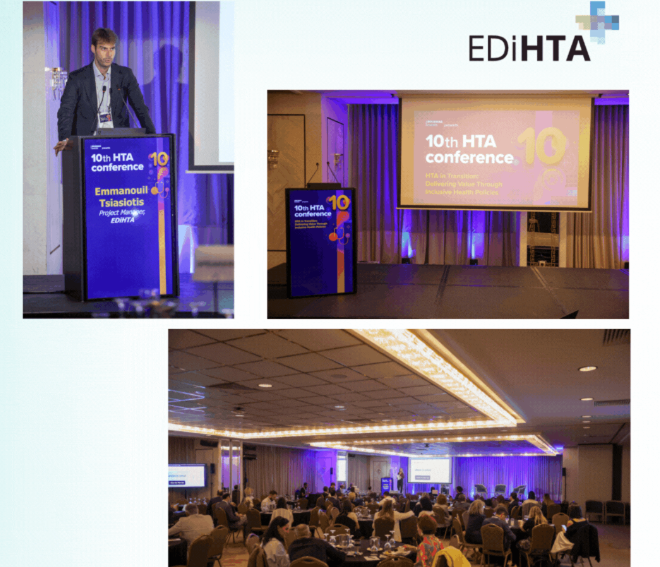
    The EDiHTA project was proud to be featured at the 10th National Health Technology Assessment (HTA) Conference in Greece, a milestone event marking the country’s progress in implementing its national HTA plan with the support of the Greek Ministry of Health, the WHO Regional Office for Europe and the European Commission.

    Representing the consortium, EDiHTA Project Manager Emmanouil Tsiasiotis presented the latest developments of the project, showcasing how EDiHTA contributes to capacity building and strengthens collaboration within the evolving EU HTA ecosystem.

    The conference also provided an excellent opportunity to connect with representatives from the Greek Ministry of Health and other national stakeholders, fostering dialogue on how EDiHTA’s harmonised framework can support future national and cross-border implementation.

    The EDiHTA team is excited to build on this momentum as the project continues to advance towards its goal of a more integrated and evidence-based European HTA landscape.
  • EDiHTA Talks #2: How to make mobile health apps accessible to patients

    EDiHTA Talks #2: How to make mobile health apps accessible to patients

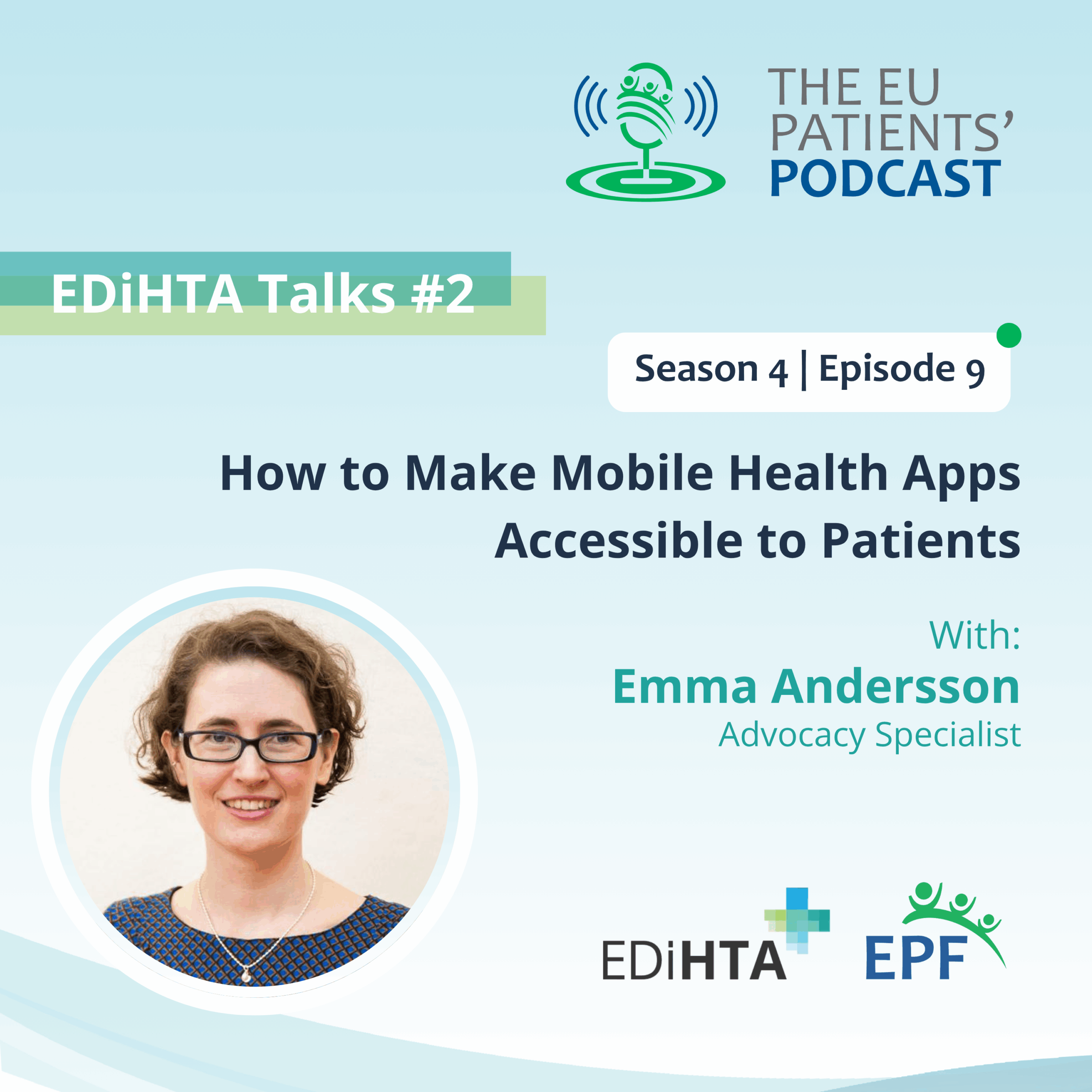
    EDiHTA Talks #2: How to Make Mobile Health Apps Accessible to Patients

    We are pleased to share the second episode of EDiHTA Talks, our dedicated podcast series hosted on the European Patients’ Forum (EPF) Podcast, bringing patient voices into the spotlight of Digital Health Technology Assessment (HTA).

    This new episode, “How to Make Mobile Health Apps Accessible to Patients,” with an Advocacy Specialist, Emma Andersson, explores the everyday barriers patients face when trying to use digital tools such as mobile health apps. With a focus on usability, inclusivity and real-world functionality, the discussion draws on concrete experiences to show why digital tools must be designed with patients, not just for them.

    The episode is part of Season 3 of the European Patients’ Podcast, produced by the European Patients’ Forum with support from the European Union.

    Click on the video and listen to the full interview on our YouTube channel.

    Key takeaways include:

    • The importance of co-creation in app design to reflect different patient abilities, needs and environments

    • Why accessibility goes beyond technical function—it includes language, literacy, and digital confidence

    • The role of regulators and assessors in ensuring apps meet real-world standards, not just market requirements

    • How EDiHTA is contributing to making future assessments more responsive to patient realities

    As with every episode in the EDiHTA Talks series, the goal is to explore how patients’ experiences, preferences and challenges can shape better health technology assessment—supporting innovation that works for all.

    Listen to the episode on EPF’s Spotify:
    EDiHTA Talks #2 – How to Make Mobile Health Apps Accessible to Patients


    Special thank you to our guest speaker Sheila Khawaja and the European Patients’ Forum team.

  • RECAP: EDiHTA joins European Commission’s HTA conference in Brussels

    RECAP: EDiHTA joins European Commission’s HTA conference in Brussels

    RECAP: EDiHTA joins European Commission’s HTA conference in Brussels

    On 2 July 2025, EDiHTA was represented at the European Commission’s flagship conference EU Health Technology Assessment: Advent of a New Era of Collaboration in Brussels. Organised by DG SANTE, the event gathered over 90 participants from across Europe, including policymakers, HTA bodies, industry leaders, researchers and patient representatives, to explore how the EU Health Technology Assessment Regulation (HTAR) can enhance collaboration, competitiveness and innovation in health systems.

    Emmanouil Tsiasiotis, EDiHTA Project Manager and Research Associate at Università Cattolica del Sacro Cuore, presented on behalf of the project during the breakout session How can we leverage HTA to boost EU competitiveness? In his intervention, he introduced EDiHTA’s co-created framework for assessing digital health technologies (DHTs), underlining the project’s alignment with HTAR principles despite DHTs currently falling outside its formal scope. He also emphasised the importance of long-term sustainability and the need to maintain stakeholder-driven processes to ensure that HTA continues to serve the evolving needs of patients, innovators, and health systems across Europe.

    This appearance follows Emmanouil ‘s participation the day before at the HTA Stakeholder Network meeting, where he represented our partnering organisation, EHMA, European Health Management Association, and contributed to reflections on the first six months of HTAR implementation, with a focus on performance monitoring and cross-sector collaboration.

    We are proud to see EDiHTA contributing to shaping the future of European HTA and supporting the vision for a more resilient, innovative and equitable health system.

    Stay tuned for more updates on EDiHTA’s activities and impact.

  • EDiHTA joins European Commission’s HTA conference “EU health technology assessment: Advent of a new era of collaboration”

    EDiHTA joins European Commission’s HTA conference “EU health technology assessment: Advent of a new era of collaboration”

    EDiHTA joins European Commission’s HTA conference “EU health technology assessment: Advent of a new era of collaboration”

    On 2 July 2025, EDiHTA will participate in the hybrid conference EU Health Technology Assessment: Advent of a New Era of Collaboration, organised by the European Commission in Brussels. The event brings together policymakers, regulators, industry, patients and experts to discuss how the new EU HTA Regulation can strengthen cross-border cooperation and support Europe’s innovation ecosystem.

    During the breakout session How can we leverage HTA to boost EU competitiveness?, Emmanouil Tsiasiotis, EDiHTA Project Manager, will present EDiHTA’s flexible, stakeholder-driven framework for assessing digital health technologies (DHTs). His talk will highlight how EDiHTA is streamlining evidence generation for innovators, accelerating safe market access for digital tools and ensuring that patient needs remain central to every assessment.

    With more than 90 participants registered, including representatives from national HTA bodies, industry, academia, patient organisations and consultancies, the session promises to spark valuable discussion on how HTA can help bring innovation to patients and boost Europe’s competitiveness in health.

Receive the latest news

Subscribe to our Newsletter

Stay informed about latest EDiHTA results, conferences, and milestones.